Wednesday, November 9, 2016

A Brief History of Men’s Style - 1960s: Rebellion & Individuality

1960s: Rebellion & Individuality

The 1960s were a decade of unrest and rebellion against the establishment and the conservatism that was celebrated in the 1950s. Clothing reflected this new attitude, especially with the youth who were more concerned with self-expression and individuality than classical dressing by the “rulebook”. The clothing industry caught on to this new wave with the youth, and offered a plethora of styles. Stores carried more variety than ever. It was approaching an “anything goes” period, where often the thing that mattered the most was not what you wore, but what you didn’t wear. 
The was also the first time that fathers began looking to their sons for advice. The first time in history that grown men wanted to look young and care-free. This trend, of course, only took us further away from the rules of elegance that were established in the 1930s.


credit: Dan Trepanier

Tuesday, November 8, 2016

These Are the 13 Coolest Sneakers of the Week

There's a lot coming this weekend, but the common theme is that everything represents a bold move. Whether it's a high-end take on two classic Vans with Offspring and Clothsurgeon, or New Balance's handmade version of the 1984 770, there are luxe updates aplenty. Nike brings back a classic with the "Black Toe" Jordan 1 while updating another classic in the "Special Field" Air Force 1 that has critics torn. Karhu celebrates a century of sneakers with Footpatrol, while LeBron celebrates his Family Foundation, and early next week Extra Butter celebrates democracy with a sneaker voted on by the people. There's a lot to see and buy this weekend—and definitely something in there for you.

VANS X OFFSPRING X CLOTHSURGEON SK8-HI & OLD SKOOL


Three heads are better than two, right? UK-based sneaker boutique Offspring teamed up with menswear designer Rav Matharu, also known as Clothsurgeon, on a collection of luxe Vans that celebrate British heritage and the impacts of streetwear. Two of Vans' most popular silhouettes—the Old Skool and the Sk8-Hi—are done up in rich suedes and veg tan leather. The typically lowbrow skate shoes have elements of broguing and zigzag cuts as a shoutout to classing British tailoring and footwear, as well as Matharu's signature designs. Watch for a very limited release to drop exclusively at Offspring and Selfridges.
Release: 11/4
£120 - £140, offspring.co.uk

NIKE LEBRON 13 LOW "LEBRON JAMES FAMILY FOUNDATION"


We don't typically include technical basketball sneakers in our weekly round-ups, but this pair of low kicks designed in collaboration with the LeBron James Family Foundation are worth the shout out. Nike has been slow on the rollout of information about these sneakers so we can't be sure if proceeds from these pairs will go to benefit LeBron's Foundation that serves underprivileged youth, but even if they merely get the foundation's name out there it's worth it. The shoes are grayscale and mismatched, with a black right sneaker and a white left sneaker. Splashes of color cover the outsole.
Release: 11/4
$160, nike.com

TIMBERLAND 6-INCH FIELD BOOT "DARK PORT"


One of the best things about fall is the chance to lace up in a new pair of boots. Timberland brings a refreshing look to its classic field boot with this Dark Port colorway. Our favorite is the 6" version, which offers significant heft and an iconic silhouette with just the right amount of color.
Release: 11/4
$185, timberland.com

REEBOK QUESTION MID "DRESS CODE"


Jordan wasn't the only NBA player who got his ish banned on the court, and no one has committed more to their style than Allen Iverson. The flashy player's signature sneaker, the Question, is done up this week in his very own personal "Dress Code" that features the denim of his baggy jeans and wheat nubuck of work boots. Banned symbols on each heel bring the message home.
Release: 11/4
$140, reebok.com


NIKE "SPECIAL FIELD" AIR FORCE 1


The most exciting update to the Air Force 1 in years is this "Special Field" version that's as high as it is complicated. Extra straps, ballistic nylon, and woven paracord add all the requisite details to make something truly unique. This weekend Nike is launching the sneaker for men in Anthracite and Faded Olive, along with a couple dope colorways for women, and an all-white version that will be available exclusively at ComplexCon.
Release: 11/5
$200, nike.com


AIR JORDAN 1 "BLACK TOE"


One of the most recognizable Air Jordan 1s ever made returns this weekend with the rerelease of the "Black Toe." Outfitted in Jordan's Bull's colors, the Black Toe is widely considered one of the top three colorways of the silhouette ever made, and sneaker fans all over the world will be clamoring for pairs this weekend. Get ready to check out fast or else you're going to miss out.
Release: 11/5
$160, nike.com


AIR JORDAN 1 HEIRESS "NIGHT MAROON"


Women get very little love from the sneaker industry, but this weekend is an exception. The velvet "Night Maroon" colorway of the Air Jordan 1 Heiress brings an underused material to a classic sneaker. The colorway is gender neutral enough that anyone can wear them (just make sure you get the right size; add 1.5 to your normal men's size). Don't let these get away.
Release: 11/5
$110, nike.com

PUMA X KICKSLAB DISC BLAZE "DESERT TROOPER"


Not everyone understands Puma's Disc and that's A-okay. The lacing system has been replaced with a tightening spinner in a design move that alienated plenty of more conservative dressers, but excited those who like something fresh. Japanese sneaker chain KicksLab took advantage of the silhouette with hairy suede in a sophisticated sand color that contrasts with black mesh on this very wearable version of the shoe.
Release: 11/5
$TBA, puma.com


VANS X BODEGA SK8-HI "INSTANT WINNER"


Legendary Boston sneaker institution Bodega challenges you to test your luck with this weekend's "Instant Winner" collaboration with Vans. The Sk8-Hi features rich pastels in blue, pink, and green offered in canvas and leather. A gum sole adds grip for this skate shoe, and an embroidered set of dice sits on the heel. Although there's no chance at play in the initial sale (everyone who pays will get a pair), each box also includes a scratch-off ticket for a shot at more winnings from the store.
Release: 11/5
$150, bdgastore.com

NEW BALANCE MADE IN UK 770


If you're looking for an exceptionally well-made, relatively conservative pair of sneakers that will reveal your style with a little bit of sophistication, New Balance has the shoes for you. The 770 is a 1984 design that New Balance has started manufacturing at its Flimby factory in the UK, bringing handmade quality to an otherwise understated shoe. This weekend the brand is offering the sneaker in burgundy and tan.
Release: 11/5
$TBA, newbalance.com

NEW BALANCE MS066


With just 40 pairs made you don't have to like the New Balance MS066; it's going to sell out whether you understand it or not. The knit laceless silhouette sits on top of a 3D-printed sole and fits like a sock. The shoe is flexible and has a challenging look, but commands a high price on account of its innovative construction and limited availability. Head over to Concepts NYC to throw your name into the raffle now, with the drawing on November 5.
Release: 11/5
$350, cncpts.com

KARHU X FOOTPATROL FUSION 2.0


Finnish sneaker brand Karhu has now been around for a hundred years, making it one of the oldest sneaker brands in the world. The company teamed up with London-based sneaker boutique Footpatrol to help celebrate the century with an earthy collaboration that draws its color inspiration from the natural world. The sneaker already released at Footpatrol last month, but this weekend it'll be available exclusively at California sneaker store Proper.
Release: 11/6
£125, properlbc.com

SAUCONY X EXTRA BUTTER SHADOW 5000 "FOR THE PEOPLE"


The Extra Butter x Saucony Shadow 5000 "For the People" releases on Election Day, a fitting sale date considering this sneaker was voted on by the public. A year ago Extra Butter made available a handful of designs for fans to vote on; the winner was produced. These sneakers, inspired by a "Nite At the Drive-In" reflect a classic 1950s car in baby blue.
Release: 11/8
$120, extrabutterny.com


credit: Pete Forester

Monday, November 7, 2016

A Brief History of Men’s Style - 1950s: The Age of Conformity

1950s: The Age of Conformity

The 1950s was the Age of Conformity. Young men returning from the military were anxious to fit right in with the establishment. Fitting in and “looking the part” meant taking on the Ivy League look, which was dominating menswear. Individuality in style of clothing was an afterthought. The goal was to look “part of the club”, in a boxy sack suit, oxford shirt, rep tie, and loafers. This was another big boost for mass Ready-to-Wear manufacturers who gladly sold the same ill-fitting tweed jackets to any young man trying to look smart and employable.
Furthermore, the 1950s saw the introduction of man-made fabrics like rayon and nylon. This was another boost to the bottom line for the clothing manufacturers who could now save significantly on the cost of fabric, while producing a garment that was thought to be “more durable and easiest to wash”. As it turns out, synthetic cloth makes for terrible menswear garments, especially in suiting. Natural fibers are always better. 
Aesthetically the period was dominated by conservative grey suits and minimalist accessories (hat, pocket square, cigarette, and martini) for just about everyone.


credit: Dan Trepanier

Friday, November 4, 2016

A Brief History of Men’s Style - 1940s: The Birth of Ready-to-Wear

1940s: The Birth of Ready-to-Wear

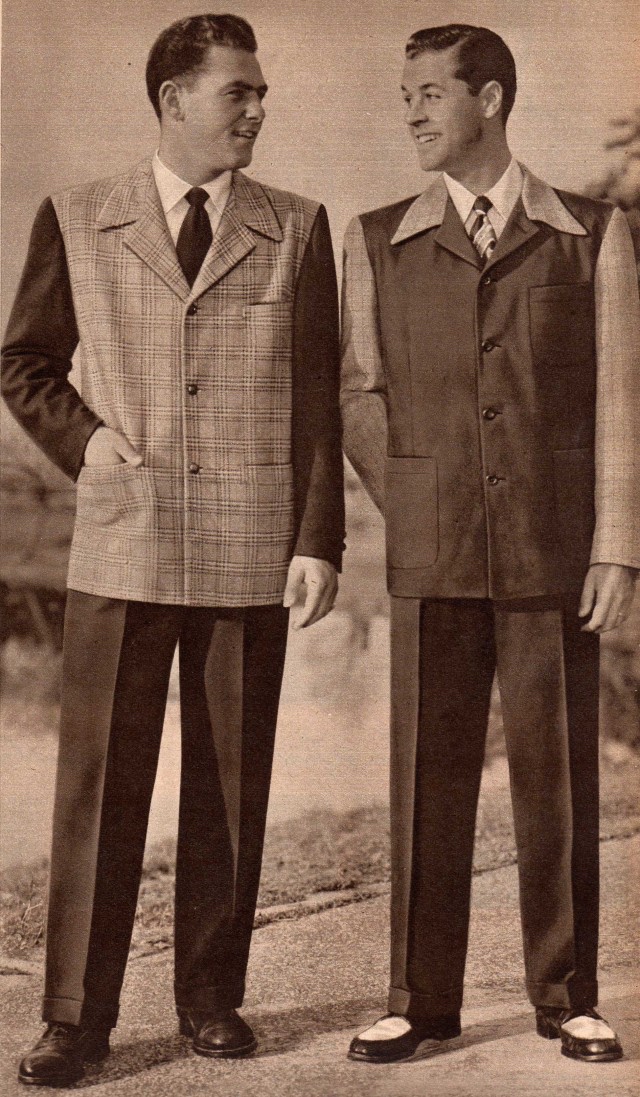
With the end of World War II, American men strayed from the high standards and basic principles of fine dress established in the thirties. Part of this was changes in the workforce and the loss of formality in everyday life. With lower demand, the price of custom tailoring rose, which allowed for the mass production of menswear to takeover as the everyday norm. This period saw the introduction of mass produced ready-to-wear clothing in America, by some brands that are still selling us clothing today.
There were positives and negatives to these new methods of mass production. On the one hand, basic clothing was cheaper and more accessible than ever. On the other hand, there was less variety in the styles being offered, and, much worse, these major clothing manufacturers realized (just like the automobile manufacturers) that they could stimulate sales by offering changes in styles every year, or even every season. This began the “trend cycle” in retail, which was created by clothing manufacturers to make more money and propagated by the magazine industry, also to make more money. 
Ultimately this marketing strategy pushed the consumer further and further away from the “ideals of classical dress” established in the 1930s, which were all about choosing long-term pieces that best flatter the body. Instead the goal of clothiers became to confuse and pressure the consumer to continually “re-invent himself” by purchasing “new styles” that are “in fashion”. More sales, regardless of the longevity or aesthetic of the look.

credit: Dan Trepanier
Wednesday, November 2, 2016

A Brief History of Men’s Style - 1930s: The Height of Elegance

1930s: The Height of Elegance

The begining of the 1930s saw the great depression. Although the average man couldn’t afford to partake in the world of fashion, many often enjoyed observing the style choices of those who could. Hollywood films on the Silver Screen became a beacon for hope for the working class man living in this era. Men and women alike looked with admiration and aspiration to elegantly dressed stars like Fred Astaire, Clark Gabel, Cary Grant, and Gary Cooper.
In the 1930s the American taste level was at its peak, rivaling that of any European country. It was a time when American men took pride in the clothing they wore and the image they projected. It was a time when men dressed by certain codes of conduct and etiquette. The “menswear rules”, which we often reference, were written in this period.
“For the first time American men realized that clothing should not be worn to hide the natural lines of the body, but, rather, to conform to them, thereby enhancing he male physique. At the same time, clothes should not be too obvious. Instead, they had to become part of the man who was wearing them. The idea of clothing was not to set the man apart (as had been the case for centuries, when kings and noblemen dressed primarily to accomplish just that) but to allow him to be an individual among individuals…. Americans had finally learned that the goal of good clothing was to flatter rather than be conspicuous.” – Alan Flusser


credit: Dan Trepanier